
Usage
Generate Go, PHP, Rust, and TypeScript clients from one Mermaid schema and execute the same statement as the same SQL in each client. Supported databases are MySQL 8 by default, PostgreSQL 12+, and SQLite 3.35+.
The complete syntax is in dsl.md, diagram syntax is in schema.md, and the IR/Plan format is in protocol.md. Dialect differences are in dialects.md, configuration is in config.md, and error codes are in errors.yaml.
1. Requirements
| Requirement | Notes |
|---|---|
| Go 1.27+ | Engine, generator, and Go client |
| MySQL 8.0.2+ / MariaDB 10.2+ | Primary target; PostgreSQL 12+ and SQLite 3.35+ use the same plan |
PHP 8.4+ (pdo_mysql) | Required for PHP; add pdo_pgsql/pdo_sqlite for those databases |
| Rust 1.98+ | Required for Rust |
| Node.js 22.12+ | Required for TypeScript |
git clone https://github.com/polyspec/orm && cd orm
go build ./...
2. Schema to manifest
The human-maintained definition is one Mermaid erDiagram (schema/bench.mmd is an example).
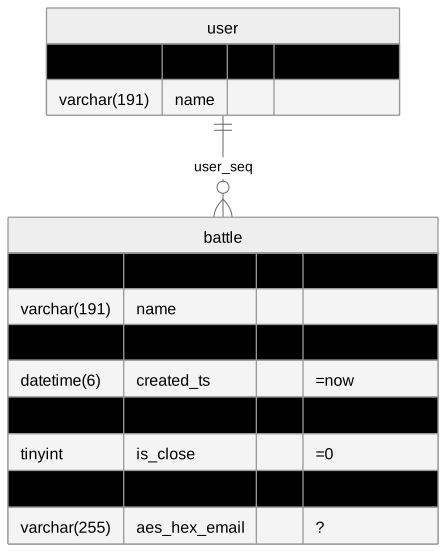
Mermaid 소스
erDiagram
  battle {
    bigint        seq            PK  "auto unsigned"
    varchar(191)  name
    text          description        "?"
    datetime(6)   created_ts         "=now"
    datetime(6)   updated_ts         "=now onupdate"
    tinyint       is_close           "=0"
    bigint        user_seq       FK  "unsigned"
    varchar(255)  aes_hex_email      "?"
  }
  user { bigint seq PK "auto unsigned"  varchar(191) name }

  user ||--o{ battle : user_seq

  %% index battle (user_seq, is_close) ix_user
  %% predicate battle visible : `is_close` = FALSE
- Comment attributes define nullability, defaults, update timestamps, auto increment, unsigned values, lazy loading, and booleans.
- Column names can imply styles:
aes_hex_*,gz_*,json_*,jsons_*,base64_*,serialize_*, andip(codec.md). - A relation line
parent ||--o{ child : fk_columndefines names on both sides (battle.user,user.battles).
go run ./cmd/ormgen build schema/bench.mmd --out schema/schema.jsonWhen starting from an existing database, import creates the same file deterministically and preserves declared attributes:
go run ./cmd/ormgen import --dsn "root@unix(/tmp/mysql.sock)/mydb" --out schema/app.mmd
go run ./cmd/ormgen import --dsn "postgres://user@localhost:5432/mydb" --out schema/app.mmd   # PostgreSQL도 동일
2.1 Create tables and generate migrations
Generate database-specific CREATE TABLE statements from the manifest:
go run ./cmd/ormgen ddl --schema schema/schema.json --dialect mysql --out create.mysql.sql
go run ./cmd/ormgen ddl --schema schema/schema.json --dialect postgres --out create.postgres.sql
go run ./cmd/ormgen ddl --schema schema/schema.json --dialect sqlite --out create.sqlite.sql
Apply the selected SQL file with the database's migration tool or client. ormgen ddl writes SQL and does not connect to a database. For idempotent database execution, use ormgen migrate against a physical database.
To create a migration, keep the previous manifest, update the Mermaid schema, build the new manifest, and generate a diff:
cp schema/schema.json schema/schema.previous.json
go run ./cmd/ormgen build schema/bench.mmd --out schema/schema.json
go run ./cmd/ormgen diff --from schema/schema.previous.json --to schema/schema.json \
  --dialect mysql --out migration.mysql.sql
Review the generated SQL before applying it. Table removal, column removal, and column definition changes require --allow-destructive with ormgen diff; the migration command rejects these changes. Renames require an explicit migration because the tool cannot infer whether a rename is safe.
The diff orders foreign-key removal before dependent index removal, applies column changes next, and creates indexes before foreign keys. It compares named indexes, unique constraints, full-text indexes, foreign-key targets and delete actions, column types, nullability, defaults, and comments. PostgreSQL emits separate TYPE, SET|DROP NOT NULL, and SET|DROP DEFAULT operations. Foreign keys use deterministic fk_<table>_<column> names and explicitly use RESTRICT, CASCADE, or SET NULL.
SQLite rebuilds a table for column removal or definition changes and for primary-key, unique, or foreign-key changes. The transaction creates a reserved temporary table, copies matching and explicitly renamed columns, replaces the source table, recreates indexes and comments, and verifies foreign keys. Every rebuild requires --allow-destructive. A new required column without a default, an existing temporary object, an existing foreign-key violation, or a dependent trigger or view fails before the first rebuild operation. Copy, constraint, or verification failure rolls back the transaction. SQLite full-text changes require reviewed auxiliary migration SQL.
ormgen migrate reads the live schema, creates orm_schema_migrations, computes a plan, applies supported non-destructive changes, verifies the live schema, and records the result. Repeating the same migration-id is a no-op only when the recorded migration and live schema match. Use --dry-run to print the plan without changing the database.
2.2 Schema source matrix
The commands below use one schema source loader. <source> accepts schema.mmd, schema.json, an SQL file created by ormgen ddl or ormgen diff, or db:<dsn>. Use --driver or --dialect to select the database format.
| Input | DDL | diff SQL | structured plan | database migration |
|---|---|---|---|---|
Mermaid .mmd | ddl --schema | diff --from/--to | plan --from/--to | migrate --schema |
manifest .json | ddl --schema | diff --from/--to | plan --from/--to | migrate --schema |
ORM .sql | ddl --schema | diff --from/--to | plan --from/--to | migrate --schema |
live db:<dsn> | ddl --schema | diff --from/--to | plan --from/--to | migrate --schema |
go run ./cmd/ormgen diff --from 'db:/var/lib/app.sqlite' --to schema/app.mmd \
  --dialect sqlite --out migrations/20260912-app.sql
go run ./cmd/ormgen plan --from schema/previous.json --to migrations/20260912-app.sql \
  --dialect sqlite --migration-id 20260912-app --out migrations/20260912-app.json
go run ./cmd/ormgen migrate --driver sqlite --dsn /var/lib/app.sqlite \
  --schema migrations/20260912-app.sql --migration-id 20260912-app
ormgen ddl and ormgen diff include orm-schema-v1 metadata with the target manifest and hash. This metadata preserves scope, codec styles, named predicates, and relation options when SQL is used as a later schema source. SQL without this metadata fails with MIGRATION_SOURCE_LOSS; the command does not infer missing ORM metadata. A db:<dsn> source is read-only. Database writes still require migrate or apply and use migration locks, history records, file logs, source checks, and post-apply verification.
Create a structured plan and apply that exact plan after review:
Migration plan files use YYYYMMDD-name.json. The filename without .json is the migration ID. If --migration-id is present, it must match that value. An invalid date, a missing name, or a different ID returns MIGRATION_FILE_NAME.
go run ./cmd/ormgen plan --from schema/previous.json --to schema/schema.json \
  --dialect postgres --out migrations/20260912-schema.json
go run ./cmd/ormgen apply --plan migrations/20260912-schema.json \
  --dsn "$ORM_DSN" --schema schema/schema.json
go run ./cmd/ormgen verify --dsn "$ORM_DSN" --schema schema/schema.json
go run ./cmd/ormgen rollback --plan migrations/20260912-schema.json \
  --dsn "$ORM_DSN" --allow-destructive
The plan stores the source and target manifests, ordered forward and rollback operations, destructive flags, and separate checksums. apply checks the live source schema before execution and rejects destructive operations unless --allow-destructive is explicit. rollback requires the same reviewed plan, an applied history row, and a live schema that matches the plan target. It executes the stored rollback operations, verifies the source schema, and changes the history status to rolled_back. Repeating the command returns noop only when the source schema and rollback file log match.
Rollback restores the schema structure described by the source manifest. It does not restore rows removed by a forward operation or values removed by a rollback operation. A plan containing a destructive operation in either direction sets rollback_data_loss_risk; rollback then requires --allow-destructive. The command rejects modified SQL, checksums, destructive flags, and risk flags before opening the database.
Rollback changes the history state from applied to rolling_back, then to rolled_back after schema verification. An operation or verification failure changes the claimed migration to rollback_failed and records the operation number, SQL statement, driver error, and final schema mismatch. A state-claim failure does not replace a state written by another migration process.
Comments are included in the manifest and migration comparison. Use %% table_comment and %% column_comment in the Mermaid source. The importer reads database comments, and the DDL generator emits dialect-specific comment statements.
Migration statements execute inside one database transaction. On statement failure, the runner records the statement number, SQL text, driver error, and whether rollback was issued. Database engines that implicitly commit DDL retain their engine-specific DDL behavior.
Migration execution uses one reserved database connection. MySQL acquires a database-specific GET_LOCK, PostgreSQL acquires a transaction advisory lock, and SQLite starts with BEGIN IMMEDIATE. A competing migration fails with MIGRATION_LOCK_BUSY before executing the first planned statement. Locks are released on commit, rollback, or connection close.
The SQL statement parser recognizes single-quoted strings, quoted identifiers, line comments, block comments, and PostgreSQL dollar-quoted blocks. Semicolons inside these regions do not end a statement. Execution errors report the one-based operation number and complete statement text.
Each apply, recovery, and rollback execution also writes a JSON audit file under migrations/logs by default. The filename is <UTC timestamp>__<migration-id>.json; it contains the driver, schema hashes, plan checksum, status, operation count, start time, finish time, and error detail. Use --log-dir to select another directory. An applied or rolled-back migration fails repeat verification if no file log matches its database record and direction.
If execution stops while the database history status is applying or failed, run an explicit recovery before retrying. Use the exact reviewed plan for ormgen apply, or use the recorded migration ID for ormgen migrate:
go run ./cmd/ormgen recover --plan migrations/20260912-schema.json \
  --driver postgres --dsn "$ORM_DSN" --schema schema/schema.json
go run ./cmd/ormgen recover --migration-id 20260912-initial \
  --driver mysql --dsn "$ORM_DSN" --schema schema/schema.json
Recovery acquires the same database migration lock and compares the live schema with the recorded source and target. A target match changes the history status to applied. A source match changes it to retryable; the same apply or migrate command can then execute the verified plan. An applied or retryable record with a matching file log returns noop. Any other schema state fails with MIGRATION_RECOVERY_UNSAFE and reports the migration ID, prior status, source hash, target hash, and live hash. This failure does not update database history or create a file log.
| Input | Required verification | Result |
|---|---|---|
| Structured plan | Plan checksum, ID, source hash, target hash, operation count, target manifest | applied, retryable, or noop |
| Migration ID | Recorded source hash, recorded target hash, target manifest | applied, retryable, or noop |
| Partial or externally changed schema | Neither source nor target matches | MIGRATION_RECOVERY_UNSAFE; no state change |
go run ./cmd/ormgen migrate --driver mysql --dsn "$ORM_DSN" \
  --schema schema/schema.json --migration-id 20260912-initial --dry-run
go run ./cmd/ormgen migrate --driver mysql --dsn "$ORM_DSN" \
  --schema schema/schema.json --migration-id 20260912-initial
3. Code generation
go run ./cmd/ormgen gen --schema schema/schema.json --lang go   --out clients/go/gen
go run ./cmd/ormgen gen --schema schema/schema.json --lang php  --out clients/php/gen
go run ./cmd/ormgen gen --schema schema/schema.json --lang rust --out clients/rust/gen
go run ./cmd/ormgen gen --schema schema/schema.json --lang typescript --out clients/typescript/src/gen
Each entity produces a query type, Row type, Where builder, and column references. After changing the schema, regenerate and redeploy. A mismatch between the generated schema_hash and the engine hash stops startup with SCHEMA_HASH_MISMATCH.
The TypeScript package is built and checked with:
npm run typescript:check
npm run typescript:build
node tests/typescript/common-vector.mjs
4. Connections
The application injects one DSN URI from its environment or Secret Manager. The URI scheme selects the database; callers do not pass a second driver value.
mysql://user:password@host:3306/app?parseTime=true&clientFoundRows=true
postgres://user:password@host:5432/app?sslmode=disable
sqlite:///var/lib/app.sqlite
Each client accepts the DSN and creates the matching native driver and pool. Schema, compiler, and AES initialization are internal runtime operations. Callers do not construct or pass an engine.
bin/ormd -listen 127.0.0.1:8080 -schema /srv/app/schema/schema.json -dialect mysqlGo
db, err := gen.Connect(dsn, options)The MySQL DSN requires parseTime=true&clientFoundRows=true because optimistic updates depend on clientFoundRows.
PHP
$db = Orm::connect($dsn, $options);Rust
let db = gen::connect(&dsn, options).await?;TypeScript
import { Db } from '@polyspec/orm-typescript';

const db = await Db.connect(dsn, options);
Each client caches plans by request shape. The compiler does not receive database rows or connect to the application database.
5. Reading
Tokens are shared; only spelling differs (PHP and TypeScript camelCase / Go PascalCase / Rust snake_case).
$rows = Battle::query()
    ->serviceSeq(7)->isClose(false)
    ->and(fn(BattleWhere $w) => $w->isDisplay(true)->or()->isAllday(true))
    ->seqIn([6, 106, 206])
    ->orderBySeqDesc()->limit(0, 20)
->using($db)->gets();rows, err := gen.Battle().
ServiceSeq(7).IsClose(false).
And(func(w *gen.BattleWhere) { w.IsDisplay(true).Or().IsAllday(true) }).
SeqIn([]int64{6, 106, 206}).
OrderBySeqDesc().Limit(0, 20).Using(ctx, db).Gets()let rows = battle::query()
.service_seq(7).is_close(false)
.and(|w| w.is_display(true).or().is_allday(true))
.seq_in(vec![6, 106, 206])
.order_by_seq_desc().limit(0, 20)
.using(&db).gets().await?;const rows = await Battle()
.serviceSeq(7).isClose(false)
.and(w => w.isDisplay(true).or().isAllday(true))
.seqIn([6, 106, 206])
.orderBySeqDesc().limit(0, 20)
.using(db).gets();- Predicates:
<Col>(v)means=, while other operators use<Col>NotEq,Gt,Gte,Lt,Lte,In,NotIn,Between,IsNull,IsNotNull,Like,LikeBinary,Contains,StartsWith, andEndsWith. TheEqsuffix is retained as a compatibility alias. An operator not allowed for the type is a compile error (OPERATOR_NOT_ALLOWED).Invalues are padded to a power of two so each list length does not create a new prepared statement; the result is unchanged. - Groups:
and(fn)andor(fn).or()connects the next predicate with OR.or()as the first group item returnsOR_AT_GROUP_START. - Column selection:
selectAll(),selectNone(),select<Col>(),unselect<Col>(),select<Col>As("name"), andselectExpr("name", "fragment").text,blob, and styled columns are excluded from the default SELECT and enabled withselect<Col>(). - Terminals:
get,gets,getCount,getsCount,countDistinct<Col>,sum<Col>,avg<Col>,min<Col>,max<Col>, andpaginate(page, per).getBy<PK>,getsBy<Col>, andgetCountBy<Col>take values only. Set the execution target withusingat the root; Go also sets its context there. Returned rows inherit the root target.getreturns null/nil/None when absent;getsandgetsByreturn non-null empty collections. - A collection is an ordered map keyed by PK or
keyBy<Col>:first(),count(), andtoArray()are available, and iteration yieldskey => row. - Row and collection map/array conversion returns
IR_INVALIDfor keys with the same string form, such as integer1and string"1". Go usesvalues, err := rows.ToArray(), Rust useslet values = rows.to_map()?, and PHP uses$values = $rows->toArray(). Use entries to retain order and key types.
Aggregates, groups, HAVING, and raw
Battle::query()->serviceSeq(7)->groupByUserSeq()
    ->having(fn(BattleWhere $w) => $w->expr('COUNT(*) > ?', [1]))->using($db)->getCount();   // 그룹 수
Battle::query()->serviceSeq(7)->groupByExpr('ROUND(`like_count`)', 'bucket')
    ->using($db)->getsCount();                                                               // 그룹별 행과 getRowCount()
Battle::query()->raw('SELECT COUNT(*) AS n FROM {table} WHERE service_seq = ?', [7])->using($db)->rawAll();
Battle::query()->visible()->serviceSeq(7)->using($db)->getCount(); // %% predicate 로 선언한 술어raw, expr, and setXExpr are for trusted code. Backtick columns such as `name` are checked against the schema and only ? is a value channel; a count mismatch returns IR_INVALID. ormgen check --lang go applies the same check to Go source before the build.
6. Relations and joins
A relation uses a separate statement. It batches parent values into IN and attaches the child rows. A join is a fragment of the same row.
$rows = Battle::query()->serviceSeq(7)->limit(0, 20)
    ->relation(User::query())                                   // one  → $b->getUser()
    ->relation(Service::query()
        ->relations(ServiceMember::query()                 // many → ->getMembers()
            ->orderBySeqDesc()->limitPerParent(3)              // 부모당 3행 (윈도 함수)
            ->keyByUserSeq()->dropChildKey()))
    ->join(Service::query()->where(fn(ServiceWhere $w) => $w->name('service-7')))
->using($db)->gets();| Child option | Meaning |
|---|---|
keyBy<Col>() | Key column for a many collection; the last duplicate wins |
keyByFn(fn) | Key the root collection with a function |
flatten() | Merge one-relation columns into the parent array; parent keys win |
limitPerParent(n) | n rows per parent using ROW_NUMBER() OVER (PARTITION BY …) |
ifParent<Col>Eq(v) | Load only when the parent row matches |
dropChildKey() | Hide the child FK in array output; retain it for binds and keys |
noCascadeDelete() | Stop point for deleteCascade |
Join children have separate on(fn) (ON clause) and where(fn) (AND in WHERE) builders. A joined entity is referenced from a root predicate through navigation: ->and(fn($w) => $w->service(fn($s) => $s->seqGt(10))). Column comparisons use generated references: $w->seqEqCol(BattleCols::serviceModuleSeq()).
7. Writes
$row = Battle::query()->setName('x')->setUserSeq(1)->…->using($db)->insert();   // 자동 PK면 다시 읽어 돌려준다
$row->setName('y')->using($db)->update();                                    // 바뀐 컬럼만 UPDATE
$row->setName('z')->using($db)->updateOptimistic();                          // updated_ts 불일치 → OPTIMISTIC_LOCK
$row->using($db)->delete();
$row->using($db)->deleteCascade();                                           // 로드된 소유 관계부터 깊이 우선, Db면 트랜잭션으로 감쌈

Battle::query()->setUuid($u)->setName('x')->…
    ->onDuplicateSetName('x')->onDuplicatePlusReadCount(1)->using($db)->insert();   // UPSERT
Battle::query()->seq($id)->plusReadCount(1)->using($db)->update();                   // 쿼리 단위 UPDATE, 영향 행 수 반환
Battle::query()->seq($id)->using($db)->delete();updatealways writesupdated_tsexplicitly so the value is consistent across dialects.minus<Col>clamps at zero. Useset<Col>Expr('read_count* ? + 1', [2])for an expression.- Transactions use each language native transaction API. The callback runs once by default. Deadlock retry requires
TransactionOptionswithretryDeadlocksenabled and is limited bymaxAttempts(default 3). - A transaction can use
savepoint(name),rollbackTo(name), andreleaseSavepoint(name)without ending the outer transaction. Savepoint names use[A-Za-z_][A-Za-z0-9_]*; invalid names fail withCONFIGbefore SQL execution. TransactionOptionscan selectisolation,readOnly, andtimeoutMs. The supported isolation names aredefault,read_uncommitted,read_committed,repeatable_read, andserializable. PostgreSQL applies transaction settings afterBEGIN; MySQL applies them beforeSTART TRANSACTIONon the retained connection. SQLite rejects explicit isolation and read-only options. A positivetimeoutMsapplies PostgreSQLstatement_timeout; MySQL and SQLite returnCAPABILITY_UNSUPPORTED.- Root row queries provide
forUpdate()andforShare()(ForUpdate()andForShare()in Go;for_update()andfor_share()in Rust). MySQL and PostgreSQL execute the selected row lock. SQLite returnsCAPABILITY_UNSUPPORTED. timeoutMsis a transaction option for PostgreSQL statement timeout. In-flight cancellation remains language-native where the client and driver expose it; there is no common cancellation method.
row, err := orm.Transaction(ctx, db, func(tx *orm.Tx) (*gen.BattleRow, error) {
    return gen.Battle().SetName("x").….Using(ctx, tx).Insert()
})$row = $db->transaction(fn(Tx $tx) => Battle::query()->setName('x')->…->using($tx)->insert());let row = db.transaction(|tx| async move { battle::query().set_name("x")./*…*/.using(&tx).insert().await }).await?;8. Styled columns
gz_*, json_*, jsons_*, base64_*, and serialize_* use decoded values, not stored bytes, at the client output (Go any, Rust serde_json::Value, PHP mixed). MySQL handles aes_hex_* and ip with SQL functions, while PostgreSQL and SQLite executors produce the same bytes (codec.md).
$b->setJsonSetting(['a' => 1])->using($db)->update();
$b = Battle::query()->selectJsonSetting()->seq(42)->using($db)->get();   // 기본 SELECT에서 빠져 있으므로 켠다
$b->getJsonSetting()['a'];
9. Multiple databases
The same statement produces the same result on all three databases, although statement text differs by dialect. Rules and exceptions are in dialects.md.
go run ./cmd/ormgen ddl --schema schema/schema.json --dialect postgres --out app.pg.sql
psql … -f app.pg.sql- Go:
gen.Connect(url, schemaPath, options); the DSN scheme selects the driver. - PHP:
Orm::connect(url, config); the DSN scheme selects the PDO driver. - Rust:
gen::connect(url, wasm, schema_json, pool_size, config).await?; the generated client creates the compiler internally. - SQLite rejects
likeBinaryand fulltext (OPERATOR_NOT_ALLOWED).
10. Operations
| Operation | Command |
|---|---|
| Compare schema with the live database | ormgen validate --dsn … --schema schema/schema.json (다르면 exit 1) |
| Check generated files | ormgen gen … 후 git diff --exit-code |
| Statement log | Config.OnQuery / onQuery / Config { on_query } → (sql, binds, 시간, plan_id, err), 비밀은 $SECRET로 마스킹 |
| View SQL without executing | ->using($db)->sql() / .Using(ctx, db).SQL() / .using(&db).sql() |
| Error constants | ormgen errors --lang go|php|rust --out … (errors.yaml) |
| Release artifacts | scripts/build-artifacts.sh → dist/(버전이 파일명에, SHA256SUMS) |
| Daemon units | deploy/ormd.service, deploy/com.orm.ormd.plist |
11. Common errors
| Code | Cause and action |
|---|---|
SCHEMA_HASH_MISMATCH | Generated files and the engine read different schema.json files; regenerate and deploy together |
OPERATOR_NOT_ALLOWED | Operator is unavailable for the type or style, such as styled columns allowing only isNull or SQLite fulltext |
COLUMN_UNKNOWN / RELATION_UNKNOWN | Name is absent from the schema; correct the diagram and regenerate |
EMPTY_IN | In received an empty array; validate before calling |
OR_AT_GROUP_START | The first group item is or() |
LIMIT_IN_RELATION | Relation child uses limit; use limitPerParent(n) |
OPTIMISTIC_LOCK | Another transaction updated the row first; read again and retry |
DUPLICATE_KEY / DEADLOCK | Mapped driver error with original text retained; deadlock follows the three transaction retries |
CONFIG | Configuration, path, or driver mismatch; the message identifies the missing value |
CODEC_DECODE | Stored bytes do not match the declared column styles |
12. Verification
go test ./...                                            # 엔진 + Go 클라이언트 + 회귀 게이트
go run ./tests/conformance/check run                     # 3언어 같은 결과 (MySQL)
go run ./tests/conformance/check run -driver postgres -dsn 'postgres://…'
go run ./cmd/ormgen tokens --schema schema/schema.json a.go b.php c.rs   # 세 파일의 토큰열이 같은지
Examples: examples/thin-slice (four clients, the same JSON) and examples/complex (joins, groups, three-level relations, and aggregates).