
schema.md — One Mermaid erDiagram is the schema source
The only human-maintained files are schema/*.mmd (Mermaid erDiagram). GitHub, IDEs, and build artifacts render them as diagrams, and ormgen parses them into a manifest (schema.json, a generated file) containing relations, kinds, indexes, and styles. Do not edit the manifest. For an existing database, ormgen import --dsn … --out schema/service.mmd creates this file (FKs become relation lines and indexes become %% directives).
1. Example
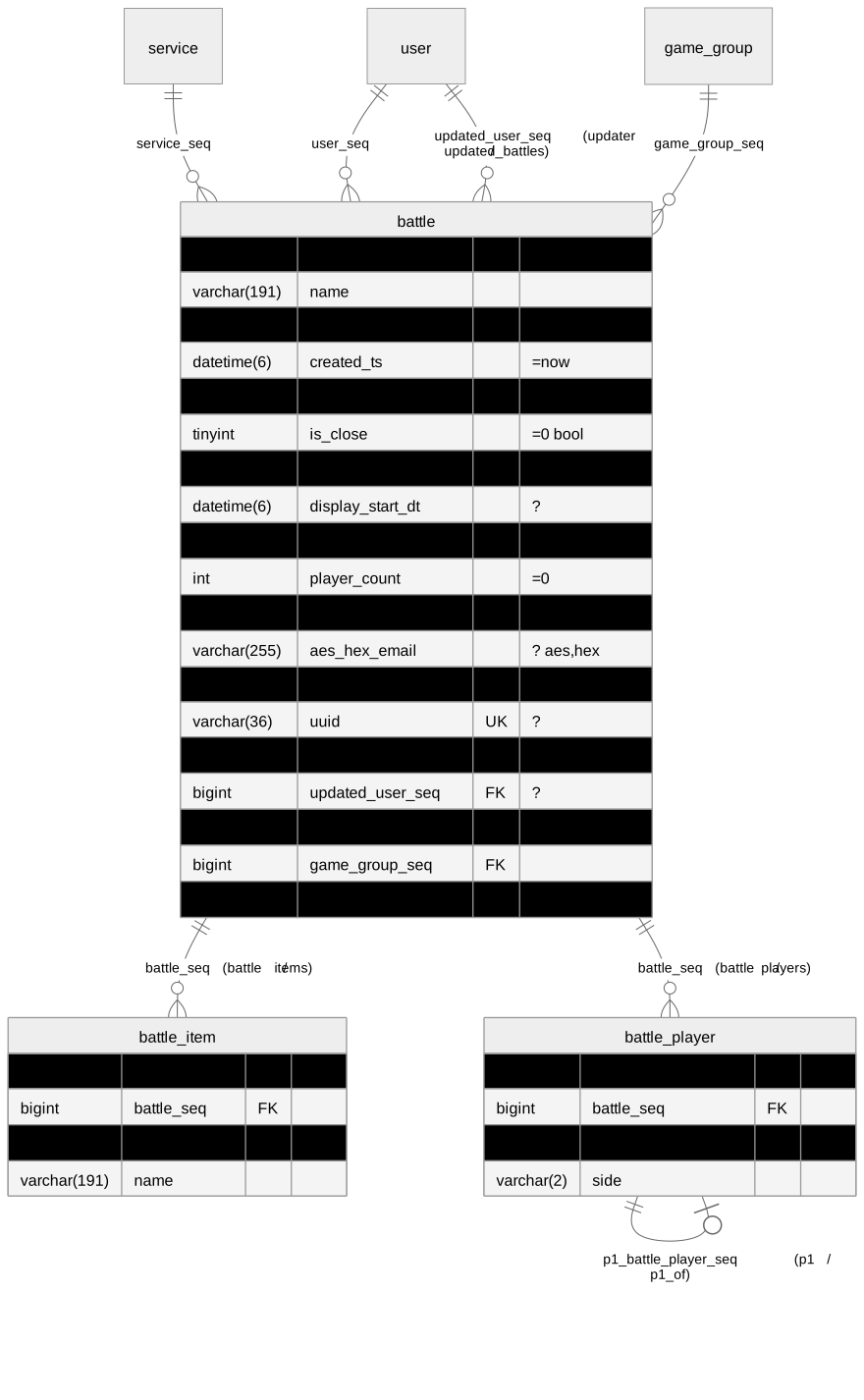
Mermaid 소스
erDiagram
  battle {
    bigint       seq                 PK  "auto"
    varchar(191) name
    text         description             "? lazy"
    datetime(6)  created_ts              "=now"
    datetime(6)  updated_ts              "=now onupdate"
    tinyint      is_close                "=0 bool"
    tinyint      is_display              "=0 bool"
    datetime(6)  display_start_dt        "?"
    datetime(6)  display_end_dt          "?"
    int          player_count            "=0"
    varchar(191) cover_url               "?"
    varchar(255) aes_hex_email           "? aes,hex"
    varbinary(16) ip                     "ip"
    varchar(36)  uuid                UK  "?"
    bigint       user_seq            FK
    bigint       updated_user_seq    FK  "?"
    bigint       service_seq         FK
    bigint       game_group_seq      FK
    int          game_group_number       "=1"
  }
  battle_item {
    bigint  seq          PK "auto"
    bigint  battle_seq   FK
    int     order_number    "=0"
    varchar(191) name
  }
  battle_player {
    bigint  seq                   PK "auto"
    bigint  battle_seq            FK
    bigint  p1_battle_player_seq  FK "?"
    varchar(2) side
  }

  service       ||--o{ battle        : service_seq
  user          ||--o{ battle        : user_seq
  user          ||--o{ battle        : "updated_user_seq (updater / updated_battles)"
  game_group    ||--o{ battle        : game_group_seq
  battle        ||--o{ battle_item   : "battle_seq (battle / items)"
  battle        ||--o{ battle_player : "battle_seq (battle / players)"
  battle_player ||--o| battle_player : "p1_battle_player_seq (p1 / p1_of)"

  %% unique   battle (game_group_seq, game_group_number)
  %% index    battle (service_seq, is_close)              ik
  %% fulltext battle (name, description)
  %% scope battle service_seq
2. Rules
2.1 Column lines — type name [PK|FK|UK] ["comment"]
This follows Mermaid syntax. PK, FK, and UK are Mermaid keywords. Mark every primary-key column with PK; declaration order defines composite-key order. Composite unique keys use %% unique below. Generated composite-key types and complete-key finders preserve this order. An insert into an entity without an automatic key requires every primary-key value and reads the inserted row with all key predicates. save rejects a partial primary key before execution. Use the database type directly (bigint, varchar(191), datetime(6), decimal(13_3), enum('a','b')). The manifest normalizes it to types such as i64, string, and datetime. varchar and char require a positive length. Schema build rejects a missing, zero, or invalid length before DDL generation.
The comment string is a space-separated attribute list. With no comment, the column is NOT NULL, has no default, and is ordinary.
| Attribute | Meaning |
|---|---|
? | Nullable |
=value | DEFAULT, such as =0, ='ko', =now (CURRENT_TIMESTAMP), or =null |
onupdate | ON UPDATE CURRENT_TIMESTAMP (for updated_ts) |
auto | AUTO_INCREMENT |
unsigned | UNSIGNED (added by import; optional when written manually) |
bool | Expose tinyint as bool |
lazy | Exclude from the default SELECT; opt in with selectX(). Text/blob types are lazy by default |
aes hex gz json jsons base64 serialize ip | dataStyle pipeline (write in order, read in reverse). Usually inferred from prefixes such as aes_hex_*, gz_*, json_*, and the column name ip |
-> table.column | Explicit FK target when no relation line exists; unnecessary with a relation line |
Other %…% | Documentation text; words that are not attributes are treated as descriptions |
2.2 Relation lines — parent ||--o{ child : "fk_column (child_name / parent_name)"
| Notation | Kind | Generated tokens |
|---|---|---|
||--o{ (1 : 0..N) | Child→parent one, parent→child many | Child: relation<Parent> / join<Parent>; parent: relations<Children> / join<Children> |
||--||, ||--o| (1 : 0..1) | one on both sides | relation… on both sides |
}o--o{ (N : M) | Unsupported directly; model a join table as an entity (a_match_b) |
Label: a single-column relation starts with the child FK column. A composite relation starts with the ordered child FK list, such as (tenant_id, account_id), and must include explicit names: (tenant_id, account_id) (account / memberships). The FK count must equal the parent primary-key count; each FK maps to the parent key at the same position. (child / parent) overrides relation names and is optional only for a single-column relation. Default names: child side removes _seq from the FK (service_seq→service, updated_user_seq→updated_user); parent side removes the parent-table prefix from the child table and pluralizes (battle_item→items, product_review→reviews, or battles without a prefix). When the same parent is referenced twice (user_seq, updated_user_seq), draw two relation lines. ormgen reports name collisions as errors.
2.3 %% directives (Mermaid ignores them as comments; only ormgen reads them)
%% unique   <table> (<col>, …)              # 복합 UNIQUE. 단일 컬럼은 컬럼 줄의 UK로
%% index    <table> (<col>, …)  [이름]      # 복합 인덱스. 단일 컬럼 인덱스는 FK면 자동, 아니면 여기
%% fulltext <table> (<col>, …)              # FULLTEXT → `<a>With<b>Match…()` 생성
%% check    <table> <name> : <expression>   # database CHECK constraint; backtick columns are validated
%% timestamps <table> created_ts updated_ts # 자동 타임스탬프 컬럼 지정(기본: 이름이 created_ts/updated_ts면 자동)
%% predicate <table> <name> : <expr 조각>   # 재사용 술어 → `<name>(args…)` 메서드. 백틱 컬럼은 검증, `?`마다 인자 하나
%% scope <table> <column>                 # query API와 IR에 독립된 tenant scope 생성
%% soft_delete <table> <column>            # nullable datetime; reads exclude non-NULL rows and delete writes the current timestamp
%% many_to_many <source> <target> <source_relation> <target_relation> through <through_entity>
%% table_comment <table> "database table comment"
%% column_comment <table> <column> "database column comment"
%% rename_table <new_table> <old_table>      # migration rename
%% rename_column <table> <new_col> <old_col> # migration rename
Rename directives are migration metadata. ormgen diff never infers a rename from similar names. A target directive generates the forward RENAME; the same structured plan generates the reverse RENAME for rollback. Keep the directive in later schema versions. If the current table or column name already exists, a repeated diff is a no-op. Missing, duplicate, self-referencing, and ambiguous rename sources fail during schema validation or diff generation.
Table and column comments are schema data. ormgen ddl emits MySQL comments, PostgreSQL COMMENT ON statements, and SQLite rows in orm_schema_comments. ormgen import reads the same database metadata and writes these directives. Changing a comment changes the schema hash and produces an idempotent migration.
many_to_many declares both typed relation names in one directive. The through entity must have one column referencing every source primary-key component and one column referencing every target primary-key component. These FK columns must form the through entity's primary key. Relation loading uses the target table with a through-table subquery and preserves the declared key order.
2.4 Optional declarations (default rules)
- A PK named
seqwithautocan be written asbigint seq PK "auto". created_tsandupdated_tsare timestamp columns by name.is_*tinyint columns are exposed as bool withoutbool; useintto disable this import default.- Text, blob, and styled columns are lazy by default;
aes_hex_*is the exception. -> table.seqis unnecessary when an FK is<table>_seqand has a relation line.
2.5 Data outside standard Mermaid and its location (CREATE replacement scope)
| CREATE element | Location |
|---|---|
| Tables, columns, types, PK/FK/UK, relations, cardinality | Standard Mermaid |
| NULL/NOT NULL, DEFAULT, AUTO_INCREMENT, ON UPDATE, lazy, styles, FK target | Column comment string (rendered as text) |
| Composite UNIQUE, INDEX order, FULLTEXT, timestamps, reusable predicates, soft delete | %% directives (ignored by renderers) |
| FK actions | cascade/setnull relation-label attributes (RESTRICT by default) |
| Three database dialect differences | Not stored in the file; fixed type vocabulary and ormgen ddl --dialect mysql|postgres|sqlite generate dialect-specific CREATE statements |
| CHECK, partitions, collation/engine options, views, triggers, functions, sequences, extensions | Unsupported by the ORM; write them in migration SQL |
Commas are invalid in Mermaid type strings; use _ such as decimal(13_3) and enum(a_b_c); ormgen interprets them. Dialect mapping from normalized types to DDL is in docs/dialects.md (S6).
3. Manifest (generated schema.json)
{
  "schema_hash": "…",
  "entities": {
    "battle": {
      "table": "battle", "pk": ["seq"], "auto": "seq",
      "columns": {"seq": {"type": "i64", "unsigned": true}, "description": {"type": "text", "nullable": true, "lazy": true},
                  "is_close": {"type": "bool", "default": 0}, "aes_hex_email": {"type": "string", "nullable": true, "style": ["aes","hex"]}, "…": {}},
      "relations": {"service": {"kind": "one", "target": "service", "left": "service_seq", "right": "seq"},
                    "items":   {"kind": "many", "target": "battle_item", "left": "seq", "right": "battle_seq"}, "…": {}},
      "unique": [["uuid"], ["game_group_seq", "game_group_number"]],
      "indexes": {"ik": ["service_seq", "is_close"]},
      "fulltext": [["name", "description"]],
      "timestamps": {"created": "created_ts", "updated": "updated_ts"}
    }
  }
}
Commit this file but do not edit the generated manifest. ormgen validate reports mismatches among .mmd, schema.json, and the live database.
3.1 Namespaced ORM extensions
The parser preserves %% orm:<kind> lines in Manifest.ORM. The core validates the directive kind, identifier syntax, key/value syntax, duplicate options, and duplicate declarations. It does not validate route, permission, public-key, or CRUD meaning. A higher-level generator owns those checks.
%% orm:field product.company_seq relation=scope fk=company.seq public=company.uuid required=true order=14. Commands
ormgen import   --dsn mysql://… --schema service --out schema/service.mmd   # DB → Mermaid (멱등: 라벨의 이름 재정의·주석 속성 보존)
ormgen build    schema/*.mmd --out schema/schema.json                       # Mermaid → 매니페스트 (검증 포함)
ormgen validate --dsn …                                                      # 매니페스트 ↔ 라이브 DB
ormgen ddl      --dialect mysql|postgres|sqlite [--tables …]                # 매니페스트 → CREATE문
ormgen gen      --lang php|go|rust|typescript                                           # 매니페스트 → 클라이언트
ormgen check    --lang php                                                   # 소스 코드 ↔ 매니페스트 (레거시 이름·expr 컬럼)
5. Validation errors (build failure)
Validation covers column naming (_and_, _or_, _with_, operator suffixes such as _eq and _gt, keywords, and __), relation collisions and reserved words, missing child FK columns, missing %% index columns, duplicate composite and column UKs, missing -> table.column targets, and FK columns without a relation line or -> target (warning).
4. Import (ormgen import --dsn … [--driver mysql|postgres] --out schema/app.mmd [--tables a,b])
The importer reads MySQL information_schema and writes the diagram. It is deterministic (alphabetical tables and ordinal columns), so an unchanged database produces zero diff on repeat.
- Types use
COLUMN_TYPE;unsignedis an attribute,is_*tinyint omits bool,decimal(13,3)becomesdecimal(13_3), andenum('a','b')becomesenum(a_b). - Attributes include
?(NULL),=value(CURRENT_TIMESTAMP*becomes=now),onupdate, andauto. - Relation lines infer the parent from
<role>_<table>_seqeven without an FK constraint, removing leading words until the table matches (updated_user_seq→user). - Indexes use
%% uniquefor composite unique,%% fulltextfor fulltext,%% index … namefor composite or non-FK single indexes,UKon a column for single-column unique, and omit single FK indexes because they are automatic. - MySQL and PostgreSQL read actual foreign-key targets, ordered columns, and delete rules from their catalogs. SQLite reads
PRAGMA foreign_key_list. Single and composite foreign keys become relation lines; composite labels use the ordered parenthesized FK list.cascadeandsetnullare preserved, and an omitted action usesRESTRICT. - PostgreSQL (
--driver postgres, or apostgres://DSN) readsinformation_schema.columns,pg_index, andpg_constraintand writes the same diagram. It normalizes types (character varying(191)→varchar(191),boolean→tinyint,numeric(p,s)→decimal(p,s),timestamp(6)→datetime(6),inet→varbinary(16),jsonb→json), maps identity/nextvaltoauto, and reconstructs generated GIN full-text indexes frompg_get_indexdef. - When
--outalready exists, the importer preserves details unavailable from the database: relation-label overrides(child / parent),lazy/bool/intand explicit column styles, and%% predicatelines. The database is authoritative for everything else.